

Rereading Lolita
Vladimir Nabokov's most famous work re-evaluated.

Having spent most of my professional career as an unlicensed mariner, I’ve often stumbled across sailors who would prattle, either in jest or with a completely serious mien, about a predilection for inappropriately young girls. On one ship back in the oughts, a bosun tried to sell me, at discount, a pair of expensive plush work boots he had bought off the internet that were too large for him with a lascivious line that would have made Al Bundy, the beleaguered shoe salesman patriarch in the television series Married with Children, shiver with envy: “You’ve never felt anything like these boots. It’s like walking on 14-year-old titties.” I did not want to ponder the possible veracity of this analogy/confession since the bosun lived in the Philippines when not toiling in his fo’c’sle.1
I chose not to ponder the implications behind this salacious (and criminal) sales pitch too much and politely declined the bargain purchase.2 I distinctly remember the age quoted as 14 but may be mistaken. In any case, the sales pitch rang my “Lolita Meter” which would light up whenever a seaman boasted in an inappropriate manner about a female somewhere between the age of 12 and 16.3 12 lighting up as red, and 16 lighting up as yellow. There is no green light on my Lolita Meter. Considering the need to break bread and socialize with coworkers, i.e. to enjoy some sort of camaraderie while aboard, I would forgive any line that could possibly have been uttered in jest or that didn’t flagrantly boast of an actual sex crime or sex trafficking. A joke is just a joke even if in extremely poor taste. And no one needs to hear the sententious orations of an over-educated scold in the crew mess or on deck. Unfortunately, I’ve been in the company of men, primarily, for too many decades to not recognize the unfortunate veracity behind the humor.
I’ve never felt comfortable with this sort of banter that masquerades, poorly, as humor. In fact, I never felt comfortable during my initial read of Vladimir Nabokov’s classic Lolita back when I was in my early 20’s nor the Kubrick film adaptation.4 Nevertheless, I’ve been on a bit of a Nabokov bender, reevaluating his novels and essays. But I was avoiding a reread of Lolita so as not to be forced to ponder the ickiness of my gender. However, with the unveiling of a vast pedophile ring in the USA run by and covered up by elites, one of whom is the President, I felt like it was time to tackle the novel anew with fresh eyes. Although this Substack veers more and more towards maritime themes since so many sailors and ex-sailors subscribe to it, I am reverting to my love of literature and am posting a straight review of a problematic book that is rightly acknowledged as a 20th Century masterpiece. Nabokov brilliantly conveys a criminal pathology in a book that is often and mistakenly classified as “erotic.”
Considered in this review:
Lolita by Vladimir Nabokov. G.P. Putnam’s Sons, New York, 1958 (Copyright 1955).
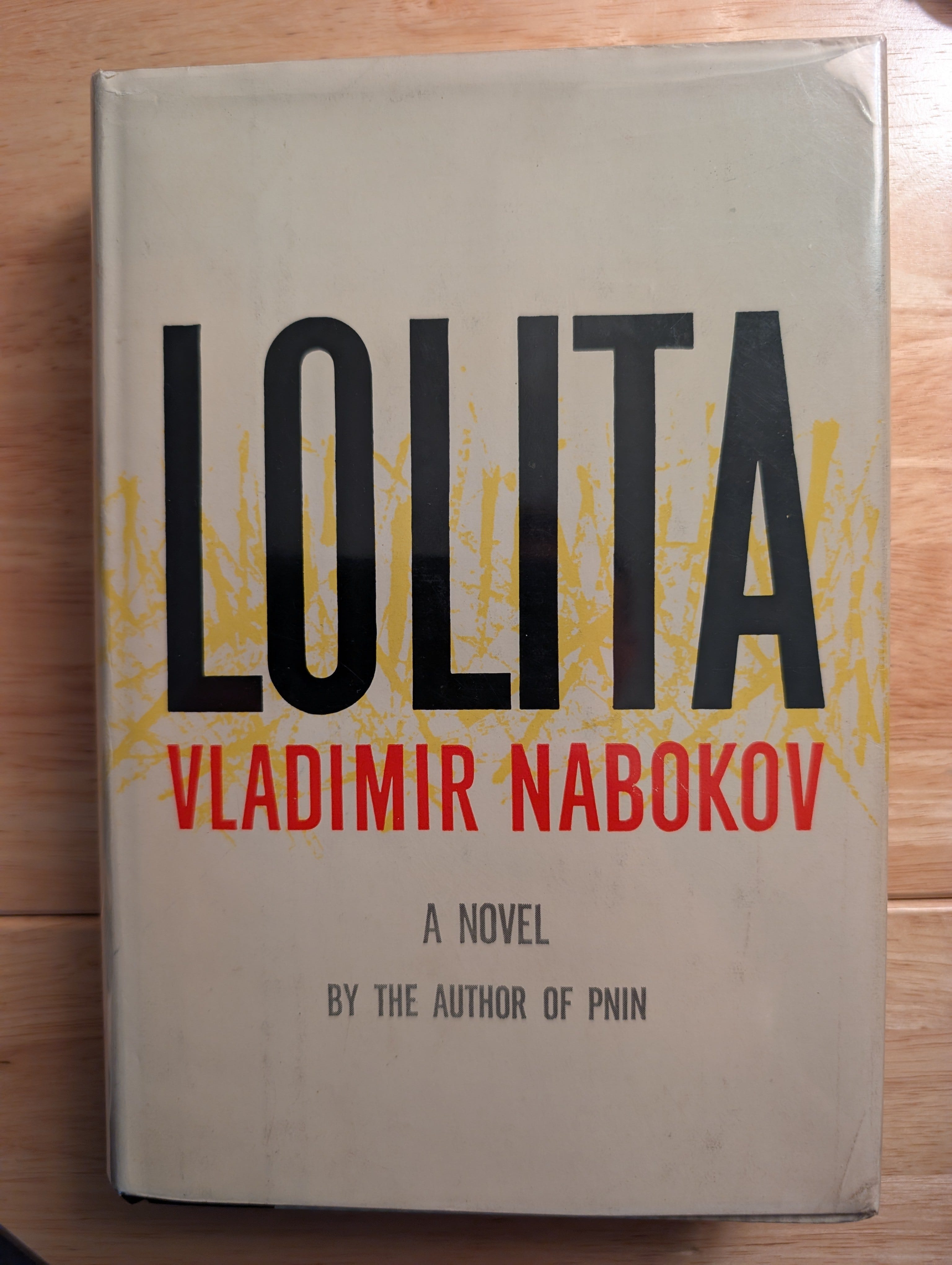
Photo: Although I had not planned on shelling out for a collectible edition of Lolita, content to read the Vintage contemporary paperback, I did stumble upon this first US edition at Mast Books in the East Village while in NYC for the NY Antiquarian Book Fair a couple of weeks ago . . . The book was priced to move, largely because the true first edition is the paperback two-volume set published by the Olympia Press in 1955 which is, typically, too valuable and fragile to actually paw or read. The bibliophile in me was sufficiently enticed to pull out a credit card. . .
It is with marked trepidation that I picked up Vladimir Nabokov’s Lolita while recently revisiting the émigré Russian’s novels. I had remembered the book as showily pretentious with the ostensibly real-life narrator, hidden behind his absurd redundant alias, Humbert Humbert, suffering from logorrhea and a compulsion to utilize every word in an English thesaurus. To make matters worse, with a reread looming, I had never been duped into believing that Lolita was, somehow, an “erotic” novel. I was revolted upon first reading it as young twenty-something and I remain revolted today.
Ah, but Lolita has indeed been classified as an “erotic novel” since its initial publication by the Olympia Press, an English language publishing house in Paris that specialized in risqué erotic texts, many of which are unabashed pornography.5 One can only imagine an oblivious frustrated traveler/reader, buying a volume of the Olympia Press imprint to help him get a stiffy or fantasize about enticing scenarios to better wax his carrot. Alas, in vain! The obsessive voluminous scribblings by an insane pederast longing for his lost “love” are decidedly unsexy. One might put the book to better use as the text for an exam to unveil pederast tendencies, with the reader hooked up to physiological monitors that detect arousal, much the way a polygraph detects somatic changes when a subject lies. During my reread, Little David remained fast asleep. The only body part that stirred was the section of my competitive writer brain that was pissed off at not recognizing obscure recondite words wielded by a polyglot author whose adopted English was seamlessly highbrow and vastly superior to my own. Quelle horreur!
So, if Lolita is decidedly not an erotic novel, or not one for a “normal” human with reasonable mores and morals, how should it be classified? As a road novel, since the wanderings of Humbert take him to various exotic locales throughout the United States, specifically the West? A “true” crime novel? Or a novel about alienation of the Other? Is it about an author showcasing various narrative techniques, like that of the “unreliable narrator? All these boxes can be dutifully checked. By the time Nabokov penned Lolita, he had already written ten novels in Russian and two in English.6 He was a master of his trade, albeit unacknowledged by all but the most astute literati. And although there are traces of autobiographical elements in some of his novels including Lolita, the book is clearly based on fictional scenario that germinated in Nabokov’s mind. This ability to confabulate out of the blue differentiates Nabokov from the run of the mill author who needs to assimilate highly autobiographical characters into his or her novels.
Humbert Humbert is Nabokov’s imaginative creation, a unique Swiss English hybrid with an obsession for young barely pubescent girls, a monster who does not resemble the author in any way other than his scintillating use of a polyglot English in a manner that strikes the native American ear as bizarre, eerie and contrived, despite its erudition. The beauty in Lolita is in Nabokov’s alien-sounding English that often forces a native speaker to read a passage two or three times to fully understand the puns and elaborate syntax. The joy in the book is not the joy of sexual description (for that is decidedly absent), but in the joy of language and the absence of obvious sexual descriptions. Sex is conspicuous in its absence. We are not treated to descriptions of Humbert Humbert’s orgasms, but his English is orgasmic and seemingly dares the reader to not become aroused by the monstrous. And the monstrous is littered throughout the novel, often veiled and in convoluted sentences, but also right in front of the reader’s face. Humbert Humbert is not just content to destroy a child, he also dreams of cannibalizing her, of molesting her friends. . .and of siring future Lolitas so he might not be guilty of mere pederasty, but also incest:
. . .I could switch in the course of the same day from one pole of insanity to the other—from the thought that around 1950 I would have to get rid somehow of a difficult adolescent whose magic nymphage had evaporated—to the thought that with patience and luck I might have her produce eventually a nymphet with my blood in her exquisite veins, a Lolita the Second, who would be eight or nine around 1960, when I would still be dans la force de l’âge;…(Page 176, use of italics reversed)
In short, only the most oblivious despicable brute picks up Lolita to become aroused. Ditto for the movie aficionados who swoon over either the Kubrick adaptation or the later one. Memo to filmgoers: The novel is a confession of an insane pederast or child molester (as well as murderer). Lolita is 12 years old when the tale begins and 17 when she dies during childbirth. . .on Christmas Day. This—of course—remains too risqué to ever portray in a proper cinema, so a compromise was reached turning Humbert Humbert into a mere statutory rapist and kidnapper, thereby passing the exquisite eyes of the censor.
I can’t help but think of the atrocious contemporary MAGA Republican apologist Megan Kelly dismissing the rapist criminal in the White House as a guy who likes “underage” girls, but only pubescent ones (Hurray for small wonders!). In the eyes of Republican morons, the President is a connoisseur, albeit a gross one, of young women, Lolitas if you will, but decidedly not children (or not decidedly if one were to ever see the full Epstein dossier). Ergo, the 1960’s and contemporary movie censors are akin to Republican apologists implicitly excusing sex crimes, e.g. mere statutory rape, by keeping child abuse or sex trafficking as completely separate and verboten subjects. Memo to moviegoers: A 16-year-old “Lolita” is an over-the-hill dowager as far as Humbert Humbert is concerned. A faithful movie adaptation of Lolita remains unfilmable.
And thus, the book remains repulsive as far as subject matter but enticing as far as the virtuoso use of English by the author. Nabokov’s English rings foreign. The tongue of an outsider who happens to be a monster. Interestingly, Nabokov wrote Lolita contemporaneously with Pnin, a fabulous novel where the protagonist is also an émigré academic out of place in a superficial materialistic land which is perfectly depicted in late 1940’s and 50’s America. The comparisons end there however since the eponymous Pnin has a heart of gold and treats his “adopted” son with protective nurturing. He is a mensch rather than a monster. The genius of Nabokov is on full display in both works as one novel gives the reader faith in humanity and the other makes one want to slit one’s wrists. Nabokov obsessives will read both. Others might only read Lolita.
One final point. Although countless (Countless!) essays have been written on Lolita, on the sensational splash of the novel, and how it has aged and how we view it in the post MeToo era, for me, the most astute point remains that the reader only “knows” Dolores (a.k.a. Lolita) through the eyes of her abuser. Lolita lacks all agency. She is mere nymphet, a sexy neologism coined by Nabokov, that has become part of common vernacular. Although I could not confirm it, I believe the first-person narrator in Nelly Arcan’s brilliant debut novel Putain utilizes the term “nymphet” often, in trying to contort herself into a fantasy for creepy male customers, a fantasy that caused Arcan to finally commit suicide as she sensed herself aging and no longer a stereotypical male fantasy. In the world of Lolita and the world of a Quebecois call girl, the female is reduced to having her allure be primarily about age and not beauty. Dolores is only a Lolita or nymphet in the eyes of a predator or criminal, and only so long as she is too young.7 To the vast majority of decent readers, she is but a mere child whose agency should be encouraged, but that point is, alas, largely overlooked.
The forecastle used to refer to the common seamen quarters in the forwardmost part of the ship, near the bow. These days, a sailor’s quarters is referred to as a fo’c’sle and is usually quite amenable, e.g. a private room, usually with a private bathroom or “head.”
The boots were too small for me. I would prefer to imagine walking on clouds. . .Alas, the boots pinched.
This occurs way more than a non-sailor might care to imagine. Wistfully orating on a predeliction for young “boys” is slightly less common, but also not as rare as one might think. . .
I did not bother viewing the remake.
The Olympia Press and its publisher Maurice Girodias are responsible for publishing 20th Century classics that, initially, couldn’t find a home elsewhere. The true first editions published by the Olympia Press include William Burroughs’ The Naked Lunch (5a), Samuel Beckett’s Molloy and Watt as well as Nabokov’s Lolita.
5a: Later retitled in the USA without the “The.”
And Nabokov was also writing the novel Pnin at the same time. Pnin ended up being published first in the USA, but by Doubleday, not Putnam. As seen in the photo of the US dust jacket of the US first of Lolita, Putnam plugs Pnin, probably in an attempt to make the work seem like a serious piece of literature akin to other works by the little-known author.
An astute reader will immediately realize that Dolores Hazes, a.k.a. Lolita, is described by Humbert Humbert as being average looking and a brunette. His obsession is with age, not beauty. Of course, in the Kubrick film Lolita, played by a gorgeous blond, Sue Lyon.
Lolita was the most shuddering reading experience I've ever had, with Blood Meridian giving it a run for the money (and now Daniel Kraus' Angel Down giving Meridian a good fight). That Dolores has no agency and is barely described objectively gives the book its horror. It's the inner machinations of a mad man who, at least in my reading 25 yrs ago, somehow made sense within the construct of his boxed-in world. And yes, it's unfilmable.