

Beneath the Wheel
Hermann Hesse and the Bildungsroman

Note: My recent Substack post dealing with students in an industrial arts class, specifically woodshop, at the elite competitive-entrance Stuyvesant High School in New York City circa the early 1980’s reminded me of the German Bildungsroman. A Bildungsroman is a novel which deals with the psychological growth and development of a protagonist, a coming-of-age novel—if you will—where education plays an important role. The protagonist is usually male. As I grapple with educational themes for future essays about Stuyvesant—while it is still fresh in my mind due to the “reunion”—as well as my time in a pseudo-military reform school in Piney Point, Maryland that I attended in order to join the Seafarers International Union—this after graduating summa cum laude at New York University—I thought I would revisit a review I wrote on Hermann Hesse’s second novel, from 1906, Unterm Rad (Beneath the Wheel). The German educational system tracks students from a very young age and makes it hard to escape predetermined fates: either a menial worker, a trade apprentice, or a student working towards a professional degree. Although I have issues, both as a student and former educator, concerning the American educational system, students in the U.S.A. generally have the ability to reinvent themselves during their educational trajectories in ways that are unavailable in the rigid German educational systems that Hesse critiques.
Discussed in this essay:
Unterm Rad (Beneath the Wheel) by Hermann Hesse, 1906.
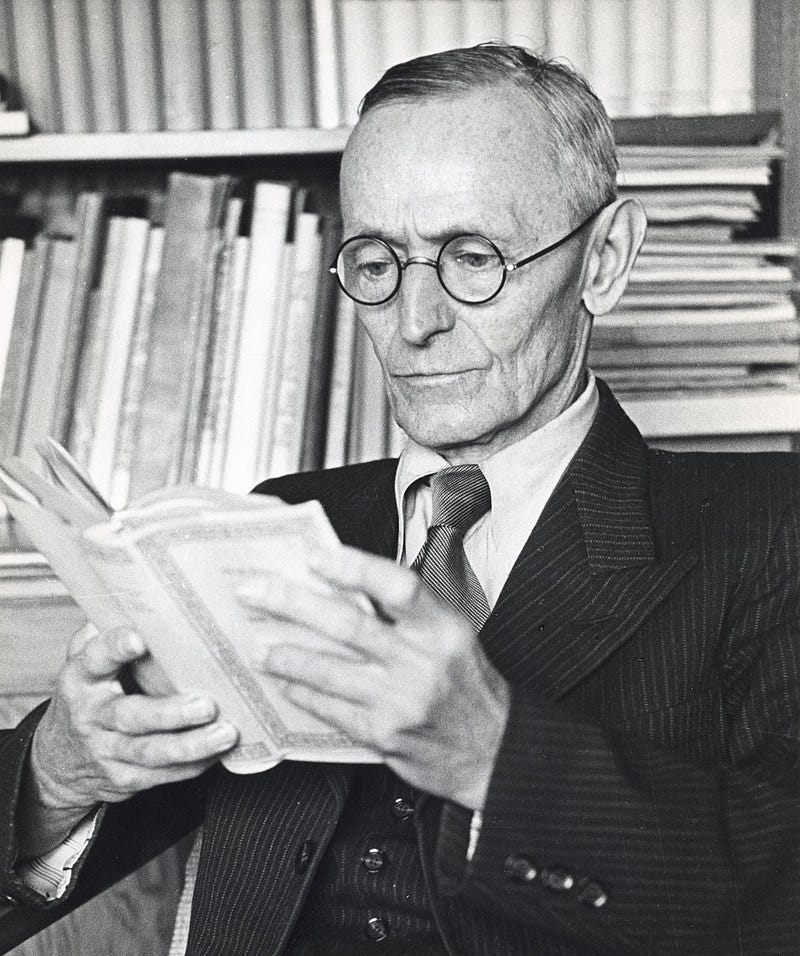
Photo: Hermann Hesse, possibly reading an edition of his Das Glasperlenspiel. Hesse often wrote of males misplaced in an educational setting.
There is, perhaps, no more redundant author in the German language than Hermann Hesse. Themes of spiritual attainment are regurgitated ad nauseam throughout his novels. In fact, his final one, Das Glasperlenspiel (1943)—for which he was lauded by the Nobel Prize committee—is so thematically similar to his second novel, Unterm Rad (Beneath The Wheel) (1906), that students of German literature might just skip the later weightier tome and just do a close reading of Hesse’s early, more obscure Bildungsroman.
German literature is no stranger to an author revisiting or rewriting a work decades after it is initially published. Towards the end of his life, Goethe famously rewrote his Sturm und Drang ode to teenage misery, Die Leiden des jungen Werthers (The Sorrows of Young Werther, 1774) in 1787. Most readers can agree that an aging author is not really adding anything noteworthy by heavily amending a book that deals with the deteriorating mental state of a young man. Considering this obvious truth, Das Glasperlenspiel (Magister Ludi or The Glass Bead Game in English translations) can be looked at as an unnecessary footnote to German 20th Century literature. Although separated by almost four decades, thematically Hesse’s second novel and his last are almost identical, albeit with the last having an artistry, narrative voice, and an elaborate hermetic insularity that allowed the author to avoid addressing World War II, then raging throughout Europe; This acrobatic act of avoidance made the Nobel committee swoon.
In both Das Glasperlenspiel and Unterm Rad, a promising adolescent gains entrance into an elite, all male school, where he is free to pursue a spiritual life sequestered from the concerns of the “real world.”1 Ultimately, each protagonist has qualms about his education, renounces (or gets expelled from) the elite institution, and drowns. Josef Knecht, the protagonist in Das Glasperlenspiel disappears near a lake. Hans Giebenrath, the unfortunate teen in Unterm Rad drowns after a pub crawl when he cannot keep up with the drinking of the experienced mechanics.2
Despite the redundancy in Hermann Hesse’s writing, there is also a simplicity and crystallization of basic truths in his better works that makes being familiar with a couple of them almost de rigueur for a reader of world literature. While most readers would list der Steppenwolf, Siddhartha, or Narziß und Goldmund as essential and relegate Unterm Rad as a minor Bildungsroman, I beg to differ. Unterm Rad is essential Hesse. His critiques of the German pedagogy still resonate. They are both timely and also applicable to different educational systems throughout the world.
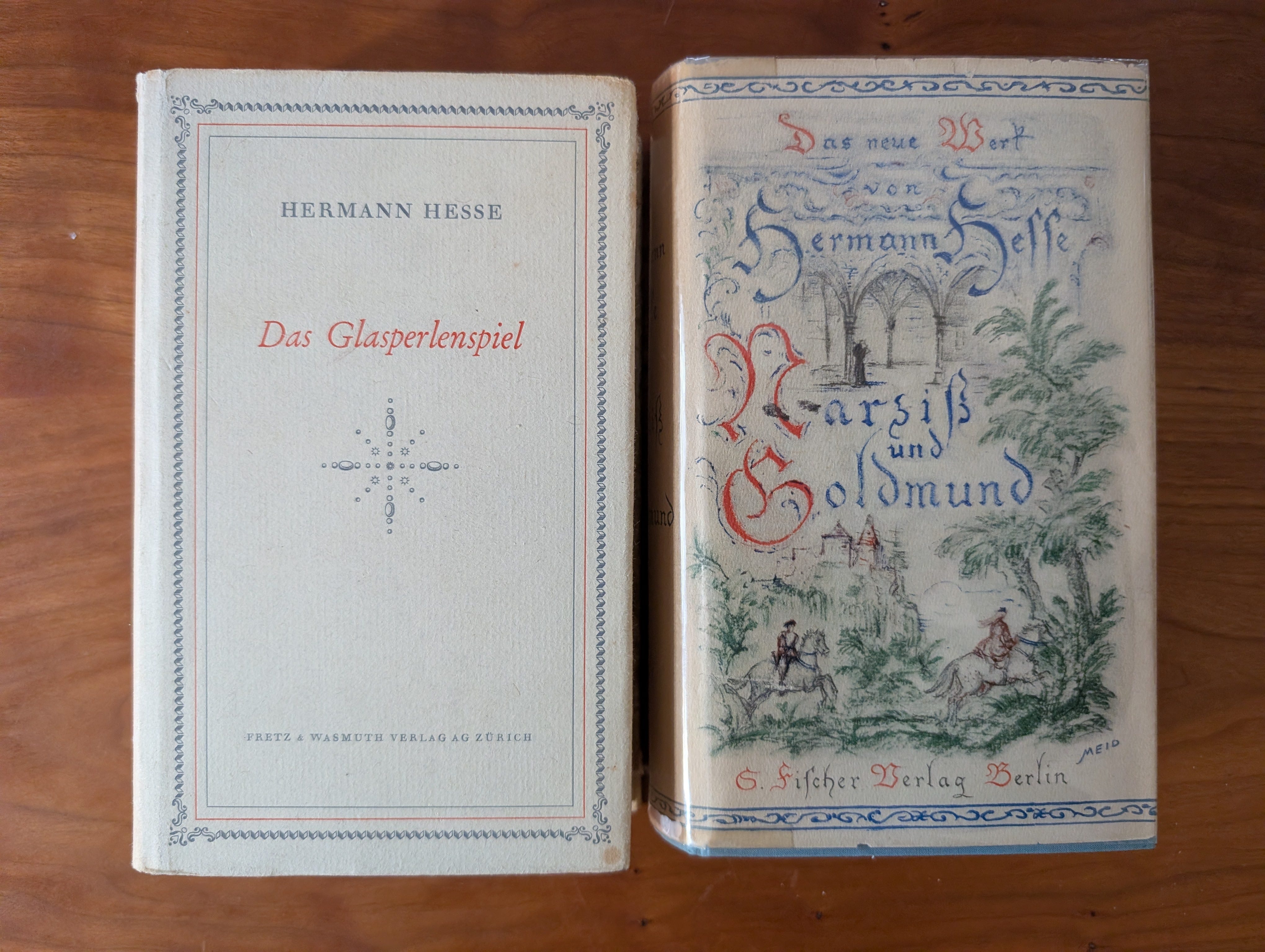
Photo: The only Hesse editions that I currently own. Regrettably, I failed to photograph the first edition I stumbled across for this essay while perusing the stacks in the Dimond Library at the University of New Hampshire last year.
The German educational system in Hesse’s era (and still, largely, today) track youth from a young age, which can lead to a life of fulfillment, but—often—a life of dissatisfaction, especially when the early tracking of a student fails to identify outlier issues. Unterm Rad is autobiographical and based, directly, on Hesse’s own failure at an elite Seminary at Maulbronn and, indirectly, on a subsequent suicide attempt.3 The seminary system in Hesse’s era selected the most promising male students based on a rigorous exam and put them in an elite boarding school. Other, less promising students, go to a gymnasium, the equivalent of a US high school, or are sent to learn a manual trade. The seminary school curriculum is quite rigorous, with proficiency in Latin, ancient and modern Greek, and Hebrew all being required. Completely absent is a system of guidance to allow young men to naturally mature and come of age or that allows them to become well-rounded individuals. In reading the descriptions of the curriculum, one feels the spiritual pain of a bright, inquiring, industrious, student being asked to learn arcane grammar points of dead languages without ever questioning why it is so important to read Homer in the original.
This is precisely the fate of Hesse’s protagonist, Hans Giebenrath. Intelligent enough to pass the entrance exam, he is better suited to outdoor activities like fishing and hiking. He falls victim to crippling headaches as town educators and religious figures implore him to study constantly to gain entrance in the seminary. After he forms a friendship at the seminary with a renegade, poetically inclined student, his fate is sealed.
Den Seminaristen wurde der Briefwechsel mit dem abgegangenen Ungeheuer verboten . . .
(The seminarist was forbidden from exchanging letters with the departed ogre. . .)
--Unterm Rad, pg, 106.
Lacking the spirit to rebel with conviction, Giebenrath gradually flunks out and must be reabsorbed, socially and professionally—which isn’t easily accomplished in German society where a round peg fits only in a round hole—in his hometown. His erstwhile less “talented” contemporaries are apprenticing as skilled craftsmen in manual trades and Giebenrath must start fresh. In Hesse’s world view, there is a constant simplistic duality and consequent lack of subtlety. In this case, the choice is either working a manual trade or enrolling in seminary school (with the gymnasium option briefly broached).
Although Unterm Rad is a work that stands up today, it does fall victim to some of Hesse’s major flaws, including the “duality” issue mentioned above. A tendency towards kitsch prose and a singular lack of well-developed female characters that borders on either misogyny or gynophobia—conditions from which Hesse seemingly suffered—also stand out to a modern reader. Hesse’s various prose diversions in Unterm Rad, Edenic descriptions of fishing and walking along babbling brooks, are tedious. Likewise, the conspicuous absence of female characters is telling and, certainly, contrived.
Hesse’s mother was a large presence in his childhood; however, the author begins Unterm Rad by describing the protagonist’s father, conveniently, a widower. As in Das Glasperlenspiel, the elite institution or seminary is all male, devoid of any female influence (The female influence might only be gleaned by studying an art such as music, but even those descriptions come across as frightfully masculine in Hesse’s prose). All interpersonal relationships are between male students. A tone of cerebral celibacy or repressed homosexuality pervades the work, constantly alluding to chaste attachment or infatuation, notably between Hilsenrath and his bad influence, Heilner. Their figurative attachment at the hip is sealed with a Judas-like kiss. Contrast these seminary chapters on “Bro Love” with the superficial descriptions of Giebenrath’s teenage love interest, Emma, a visitor to his town whose only real defining characteristic is her ability to be a successful cock tease. Hesse—who would never use such a crass term—wastes paragraphs describing her rosy cheeks and how she guides Giebenrath’s hand towards her thigh. A graduate student armed with a thesaurus might have a ball identifying all the Greek terms that Hesse employs to avoid writing about sexuality in a straightforward manner. “Synecdoche” comes to mind.
Hesse’s avoidance of sexuality (excluding Der Steppenwolf which also contains the pitfall of Hesse’s simplistic insistence of duality) is even more irksome because other German authors of the era are not so puritanical. Hesse’s self-censorship on issues concerning male heterosexuality mars Unterm Rad, which otherwise is a perspicacious and accurate condemnation of the German educational system ranking with other great 20th Century German Bildungsroman that accurately castigate Germanic pedagogy, particularly in boarding schools, and foretell the German tragedy of World War II: Musil’s Die Verwirrungen des Zöglings Törless; Robert Walser’s Jakob von Gunthen4; and either film version of Mädchen in Uniform.5
“Real world” has to rank as one of the most annoying phrases in the English language. It is often used by someone with a grudge against academia to imply that those who make their living through education or by being affiliated with an academic institution are somehow living in a fantasy world that does not count as “real.” When confronted with their idiocy, these platitude spouters usually retreat.
Needless to say, binge drinking was not taught at the seminary school.
Suicide is a frequent theme in Hesse’s writing, so much so that when I see a person, usually male, with multiple Hesse volumes, I assume at least one suicide attempt.
Jakob von Gunthen quite literally relates the adventures of a young man in a school for lackeys or servants. To prove my point on prudery and on Hesse’s repressed nature and sense of propriety, he objected to a scene in Walser’s work in which what today would be described as a “sexual assault” occurs. To Hesse, this unwanted intrusion of vérité ruined his reading experience. See notes on Jakob von Gunthen in any Suhrkamp edition.
The books mentioned have all been adapted to film and are memorable.
Splendid insights. Brilliant synthesis.