

Amanda Knox Redux
A Misunderstood Maligned Heroine with a Mature Voice

Note: The below review naturally assumes familiarity with the whole media frenzy that surrounded Amanda Knox after she was falsely convicted of murder. The frenzy lasted almost a decade. It is virtually impossible to not have heard or had some sort of opinion on Amanda Knox. In this review, I compare her new book with her early memoir written shortly after she was repatriated. The link to my review of Waiting to Be Heard is embedded in the text below and is well worth a look to gain further understanding of her new book.
Free: My Search for Meaning by Amanda Knox. Grand Central Books. Published March 2025.

Photo: The author photo which discreetly appears on the back jacket of Free, not the front cover. Kudos to Grand Central, her publisher.
Twelve years have passed between Amanda’s Knox’s completely expected explanatory and exculpatory memoir Waiting to Be Heard (2013) and her most recent offering, Free: My Search for Meaning, which is specifically not marketed as a memoir.1 Ms. Knox most likely lacked the wherewithal back in 2013 to retain more artistic control over Waiting to Be Heard. Predictably, the author photograph adorns, nay, dominates, the dust jacket of her memoir; although the title is a plea to be listened to and understood, her publisher, Harper Collins, opted for the obvious marketable cover jacket optics, the ones that initially got Amanda Knox in trouble: she is a good looking all-American type girl whose pulchritude was her downfall.2 Of course, Harper Collins had an advance to recoup and Ms. Knox and her alleged sex appeal were a household name.
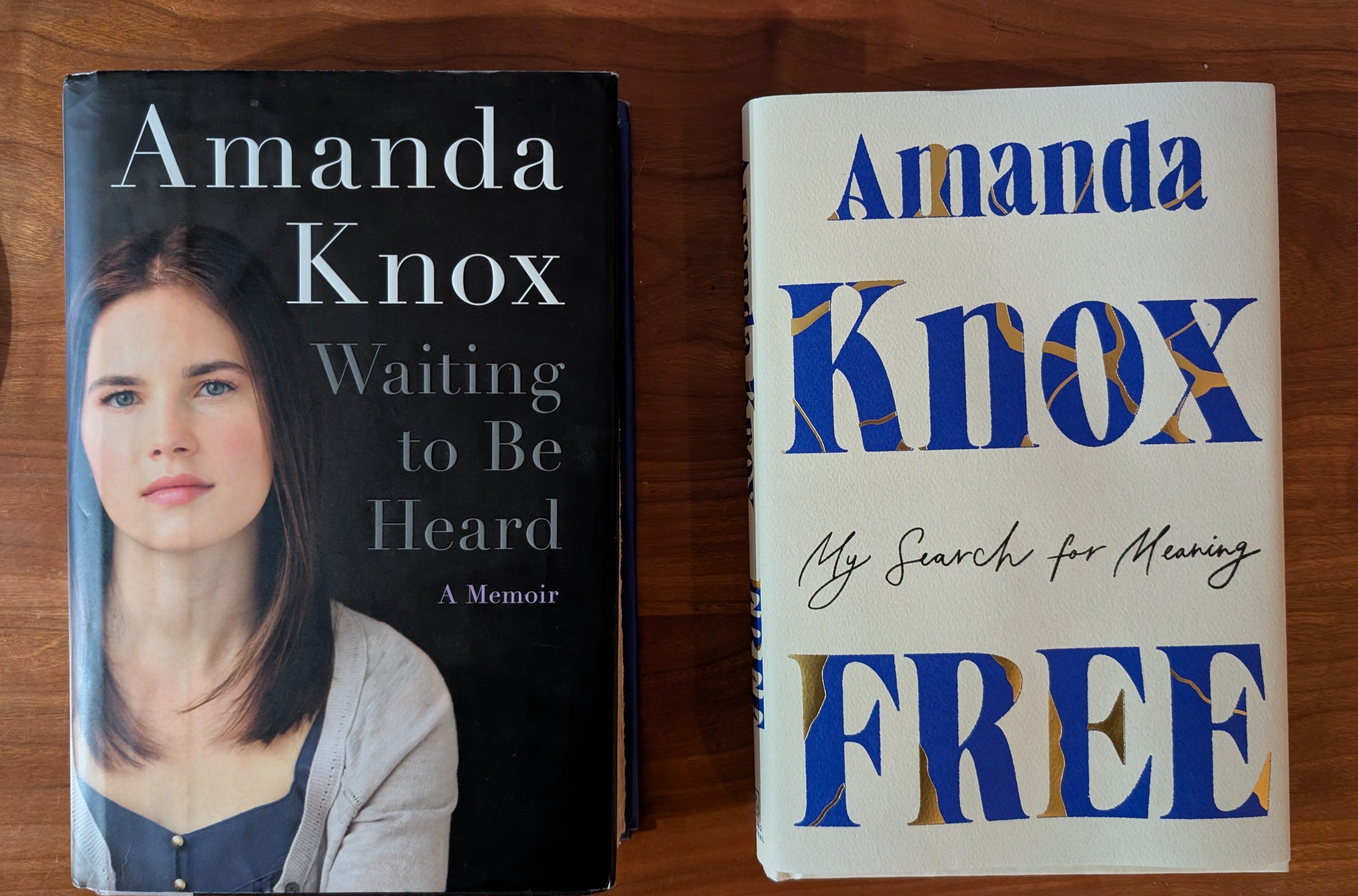
Photo: My copies of Ms. Knox’s books. Note the difference in marketing.
I have always been a huge Amanda Knox supporter. Fair disclaimer: I lived near her families West Seattle neighborhood for almost a decade,3 including while she was falsely accused and sentenced to a lifetime in a foreign prison. Appeals for her released echoed through my West Seattle haunts where there was very little doubt as to her innocence. As a former ex-patriot and then, active deep-sea sailor, I was well aware of problems that US citizens can run into abroad and how Americans—particularly young women—are viewed in Europe.4 After Ms. Knox was finally—alas temporarily—acquitted, I felt joy that was only tempered by my horror at the US paparazzi5 who descended upon the Knox household and neighborhood. I changed my daily cycling training route due to hovering helicopters and huge media trailers which dominated the landscape and transmogrified my sleepy West Seattle neighborhood into a circus side show for almost a month. This made me empathize with Amanda Knox all the more. In the years that followed, there were Knox sitings in my local used bookstore and restaurants. It was rumored that she was writing for the West Seattle Herald, a yawn-inducing local weekly. I remained steadfast in my horror at what happened to her, only occasionally mustering up an inappropriate joke at my dinner parties about how many Americans would long for the opportunity of a free complete immersion language course to master everyday Italian [snicker, snicker].6
When Waiting to Be Heard finally appeared to much fanfare, I did not line up to buy a copy, but—fortuitously stumbled upon a discarded but nicely preserved used one7 on the free bookshelf at my local post office in rural NH years later, during the pandemic. Her notoriety was that ubiquitous. I lapped up her memoir in a sitting and gave it a very positive review, comparing her plight to that presented in two timeless works of literature: Henry James’ Daisy Miller and Albert Camus’ L’Etranger. Truth is indeed stranger than fiction. Amanda Knox presented as a disarmingly strong writer of potential whose absurd and awful situation overshadowed her prose and insights.
My initial Goodreads review of Waiting to Be Heard
Above all else, I wanted Ms. Knox to find some peace and serenity after all that had occurred, but I feared that her Paradise Regained in bucolic West Seattle would have inevitable snares, that her life could hardly ever be ordinary despite the mundane backdrop of Easy Street records at the Junction and with the University of Washington eager for her to complete her undergraduate degree. Thus, I was initially skeptical and didn’t want to see her exploited again. The memoir appeared too soon, at least in my opinion. I understood that her family had crushing legal bills, and that Ms. Knox certainly needed to finally tell her story, without the media framing it. I never judged Waiting to Be Heard. Instead, I loved it immediately, flaws and all.
Free, the non-memoir that still is a memoir, albeit a contemplative one, is a more mature offering that offers additional insight and perspective on her fate and continued ordeal. The voice is that of a thirty-something, not a twenty-something stepping out of a vortex of hopeless solitude trying to regain a lost half decade. Time and Distance are central characters, though Ms. Knox is never far from the judgmental hordes. She is savvier this time around. She has chosen a publisher, Grand Central, that is less keen on marketing her for a quick buck and instead allows her to just reveal her personality, her interest in language, and her unique story. Her story truly begins when the sensationalism ends, when day to day life becomes a struggle. Her last name is the same size font as the title Free, not dwarfing it as in the early memoir. Her author photo appears discreetly on the back jacket, not the cover. She is older, in her thirties, and a mom. She is dressed stylishly and quirkily in front of her well-stocked polyglot bookcases—presumably at her home on Vashon Island—an enclave separated from West Seattle or Downton Seattle by a short ferry ride—where she can live in peace without gawkers showing up on her front lawn. One thing that hasn’t changed: she still doesn’t offer much of a smile. The smile is forced, which is not surprising because she was robbed of her carefree youthful existence.8 And this is what makes Free so compelling. It is the story after the story, which—as anyone with the perspective of increased years knows—is the relevant one.
When reading a book, I usually cull quotes to incorporate into a review. However, Amanda Knox has largely spent her life having it framed by others. Her words and actions have been used against her ad nauseam to make her appear a craved hussy capable of a ritual murder. Even some bitter scolds who think she is innocent, deplore and judge her implication of the Congolese bar owner,9 as if they could withstand 50 hours of intense questioning, and the physical and psychological abuse that amounted to torture.10 I will not quote freely from Amanda Knox’s new book. Nor will I repeat any tale she relates in it since that might lead to me analyzing or judging; I will not appropriate her story. Her story is her’s alone to tell, not mine or anyone else’s. Amanda Knox has been judged constantly and meanly for almost two decades. And those who judge her are only revealing their own biases and their own misevaluation on how they would have behaved differently, e.g. not caving after a fifty-hour inquisition (Sure they wouldn’t!). Suffice to say, that Ms. Knox grapples to understand other women who have been tried by media. That, she understands the healing process and forgiveness. She even alludes to biases I revealed in my initial review of Waiting to Be Heard when I compared her prosecutor and adversary, Dr. Giuliano Mignini to a Brüder Grimm villain. Free culminates with Amanda Knox reaching out to Mignini during a return to Italy and Perugia where she met with him amicably face to face. Very few humans, and certainly not those prone to judgment, could even contemplate such a magnanimous empathetic action. I literally recoiled and felt jittery as she relates her mental state leading up to the meeting, her need for reconciliation, understanding, and, as the secondary title of Free proclaims, her “search for meaning.”
Ms. Knox is a survivor, an exoneree, a journalist, and a mom. She is an activist for the falsely accused and a co-host of a successful podcast with her author and partner;11 she works with people who were on death row and who served twenty-year sentences, mostly minorities without the all-American pulchritude whose alleged crimes never led to a media frenzy or a salacious nickname. Amanda Knox has regained her voice after an awful experience. Her voice is utterly compelling and her own.
Although Free has a memoir like feel, it is more of a rumination on life. Not a self-help book, but a book—as the title implies—in search of meaning.
I feel odd commenting on Amanda Knox’s appearance. She is of a completely younger generation. To me, she just looks like a kid. I comment only in so far as stating the obvious: Her looks were her curse.
30 years in all, so the places she relates and even some of the people she thanks in her acknowledgement section are readily identifiable.
American women are falsely stereotyped as loose and promiscuous, especially in Catholic countries.
Amanda Knox was such an international sensation that actual European paparazzi descended upon West Seattle.
One of the more fascinating aspects of Free is Ms. Knox’s love for the Italian language and languages in general. All jokes aside, Ms. Knox is an atypical American in that she shows interest and aptitude for foreign languages.
As a bonus, it was a well preserved first edition, not that it is hard to find. The print run must have been enormous. I made a deliberate effort to buy Free from my local bookstore, so that Amanda Knox gets her cut.
I feel terrible commenting on Amanda Knox’s smile. It is not really my place to do so. And I may misread the photos because I never met her. However, I feel that the strained smile is telling and tragic, ergo I am making an exception. Mea culpa.
See my initial review.
Perusal of the reviews on Goodreads for Waiting to Be Heard will not strengthen anyone’s faith in humanity. The torture Knox endured has never been emphasized enough.
My partner, Alison, listens to Knox’s podcasts regularly.
In Knox's podcast, one theme that is repeated over and over again, is that nobody is the sum of their worst mistake. While in prison in Italy, Knox, innocent of the crime she was accused of, played cards with women who killed their children, and found empathy for them. I find her deep level of empathy compelling. Her podcast with her partner, Christopher Robinson, is wonderful! It takes on anything from Star Trek, the magic of fungi to those who are wrongly accused. Knox is very bright and entertaining, as is Christopher Robinson, and their banter is enlightening. Knox is so much more than the worst thing that ever happened to her, as much as the trauma of her time in Italy impacts who she is today. I agree with Knox in that nobody is the sum of their worst moment and I will add that nobody should be defined by their trauma.